"Cable gland connector" gets used loosely in the field, and that loose usage causes real ordering mistakes. The part in question, in most cases, is a cable gland, sometimes called a cord grip or cable fitting. It seals and secures a cable at the point where it enters a panel or enclosure. A true cable connector is a different animal built to join or disconnect electrical conductors.
This guide clears up that naming confusion, then walks through how cable glands work, the main types available, and how to pick the right one for a given job.
Cable Gland or Connector: What Is the Actual Difference?
A cable gland handles mechanical and environmental work at a cable entry point. It grips the cable so tension and twisting cannot pull it loose, seals the opening against dust and moisture, and, on armoured cable, carries a path to earth through the metal armour.
A cable connector does something else entirely. It joins two cable ends, or a cable to a device, so that current or signal can pass between them, and it is often built to be plugged and unplugged intentionally. USB, coaxial, and circular industrial connectors fall into that category.
The two parts frequently work together in the same panel: a connector makes the electrical joint, and a gland seals and anchors the cable where it crosses into the enclosure. Confusing the two on a purchase order usually means the wrong part shows up.
How a Cable Gland Connector Works

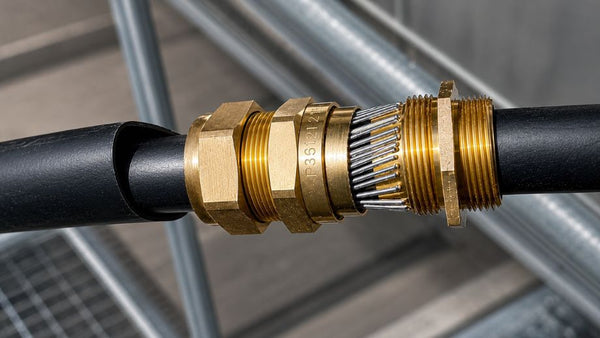
A cable gland connector is built around a central body that the cable passes through, with a handful of supporting parts doing specific jobs:
- Locknut hardware secures the gland to the enclosure wall.
-
A clamping cone or claw grips the cable, and on armoured versions, grips the armour layer specifically.
-
A sealing washer compresses against the cable jacket to keep out dust and water.
-
A compression nut tightens down to hold that seal in place.
Installation follows a consistent order regardless of manufacturer:
-
Thread the components onto the cable.
-
Seat the cable through the body.
-
Tighten the clamping mechanism to grip the cable or armour.
-
Tighten the compression nut to finish the seal.
Getting the torque right matters. Too loose and the seal fails. Too tight and the cable or armour can be damaged.
Types of Cable Gland Connectors
Cable glands break down along three practical lines: compression class, armour compatibility, and material.
Compression Class
Single compression glands seal at one point, typically the cable jacket, and suit dry, indoor, low-vibration installations. Double compression glands add a second seal, usually at the outer sheath in addition to the inner grip, which makes them the standard choice for outdoor, washdown, or high-vibration locations.
| Feature | Single compression | Double compression |
| Sealing points | One | Two |
| Best for | Dry, indoor, low-vibration entries | Outdoor, washdown, or high-vibration entries |
| Typical IP rating | Lower ingress protection | Higher ingress protection, often IP66 or better |
| Common use case | Control cabinets, interior panels | Motors, pumps, outdoor junction boxes |
Armour Compatibility
Armour compatibility splits glands into unarmoured designs, built only to grip a plain cable jacket, and armoured cable gland designs, built with a cone or claw that clamps the metal armour layer directly and provides a path to earth. Manufacturers sometimes label these with letter codes such as A for unarmoured and B, C, D, or E for various armoured configurations, though the practical question to ask is simpler: does this cable have armour, and does the gland need to ground it?
Material
Material choice comes down to environment and budget. Brass is the most common choice, offering solid corrosion resistance at a reasonable cost. Stainless steel holds up better in marine or chemically aggressive settings. Nylon covers lighter indoor applications where cost matters more than mechanical toughness.
Common Applications for Cable Gland Connectors

Cable glands show up anywhere a cable crosses into a sealed enclosure:
-
Power distribution panels, motor control centers, and switchgear cabinets rely on them at every conduit and cable entry.
-
Outdoor junction boxes and disconnect enclosures need them for weatherproofing as much as for strain relief.
- Process and manufacturing equipment exposed to washdown, vibration, or chemical spray depend on a properly rated gland to keep the enclosure's protection rating intact.
-
Pairing the gland with liquid tight fittings on the conduit run adds a second layer of protection in wet or washdown areas.
- Telecommunications and instrumentation cabinets use lighter-duty versions for indoor signal and control wiring.
Choosing the Correct Cable Gland Connector
Start with the cable itself. Measure the outer diameter, note whether it is armoured, and confirm the enclosure's thread size before ordering. A gland sized off a datasheet instead of the actual cable can end up too loose or too tight, since outer diameters vary between manufacturers even at the same conductor size.
Match the IP rating to the environment, not just the cable. A dry indoor panel rarely needs the same protection as an outdoor junction box exposed to rain and washdown spray. For industrial cable gland selection on a working job site, having sizes and materials in stock matters as much as picking the right spec, since a mismatch found mid-install can stall the whole panel build.
For armoured cable specifically, confirm the gland includes an earth tag or equivalent grounding provision. Skipping that step on a job that requires grounding continuity is a common reason installations fail inspection.
Final Thought
A cable gland connector is really two different things wearing one confusing name: a sealing and strain relief fitting on one hand, and a true electrical connector on the other. Knowing which one a job calls for, and specifying the right compression class, armour compatibility, and IP rating, keeps an installation sealed, grounded, and passing inspection the first time.
Get the Right Fitting in Stock, Ready to Ship
A missing or mismatched cable gland can stall a panel build over a part that should have been a quick order. Industrial Fittings Now stocks a full range of cable glands, cord grips, and related sealing hardware across compression classes and materials, so your crew gets the correct fitting without waiting on backorder.
Contact us to confirm stock and pricing on the size and type your job calls for, including hard-to-find or discontinued fittings.
FAQs
Is a cable gland the same as a cable connector?
No. A cable gland seals and secures a cable at an enclosure entry point. A cable connector joins two cable ends or a cable to a device so current or signal can pass through.
What does IP rating mean on a cable gland?
It indicates how well the gland resists dust and water ingress. Higher numbers mean better protection. Outdoor and washdown applications typically call for IP66 or higher.
Do I need a double compression gland for every job?
No. Dry, indoor, low-vibration installations can usually use single compression. Double compression is worth the extra cost anywhere the entry point faces moisture, washdown, or heavy vibration.
Can a cable gland provide grounding on its own?
Only on metallic glands designed for armoured cable, and only when the gland includes a proper earth tag or bonding provision. Unarmoured or plastic glands do not provide a grounding path.
What happens if I install the wrong size cable gland?
An undersized gland will not seat properly over the cable or armour, and an oversized one will not achieve a tight seal no matter how much the locknut is tightened. Either mistake can lead to a failed seal or inspection.