Every steel wire armoured (SWA) or aluminium wire armoured (AWA) cable run ends somewhere, and that entry point is where a job either holds up under vibration, moisture, and load, or fails months later. An armoured cable gland is the fitting that makes that connection permanent: it grips the cable armour, seals the enclosure opening, and keeps a path to earth intact.
This guide breaks down what an armoured cable gland is, how each part functions during termination, and how to size and order the right one so a maintenance call or panel build does not stall out waiting on the correct fitting.
What Is an Armoured Cable Gland?
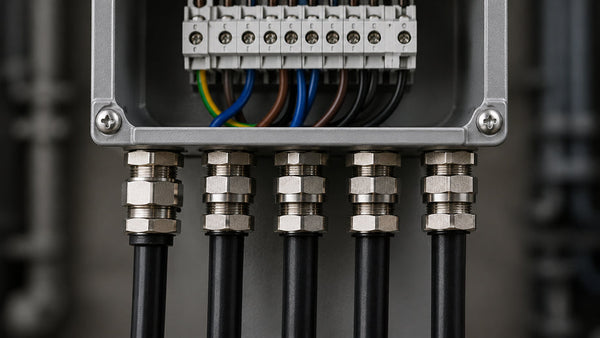
An armoured cable gland is a mechanical fitting that terminates SWA or AWA cable where it enters a panel, motor, junction box, or other enclosure. Unlike a standard gland made for plain-sheathed cable, an armoured gland is built to clamp the metal armour layer directly, which does two things a basic gland cannot: it locks the cable in place under pull-out force, and it carries a path to earth through the armour for fault protection.
Contractors and maintenance teams reach for armoured glands anywhere cable runs underground, through a wall, or into equipment exposed to moisture, vibration, or physical impact. Power distribution panels, pump stations, conveyor drives, and outdoor junction boxes are common installation points.
Components of an Armoured Cable Gland

A typical armoured gland is built from five working parts, each doing a specific job during termination:
-
Gland body: The outer housing that threads into the enclosure and holds every other part in sequence.
-
Armour cone (spigot): A tapered piece the stripped armour wires spread over, which spaces the armour evenly around the cable before it is clamped.
-
Compression or clamping ring: Tightens down over the cone to trap the armour wires in place without crushing the conductors underneath.
-
Sealing washer or ring: Usually rubber or a similar flexible material, compressed against the outer cable sheath to keep out moisture and dust.
- Locknut and earth tag: The locknut secures the whole assembly from inside the enclosure, and an earth tag, when fitted, bonds the armour to the enclosure's grounding system.
Gland bodies are most often machined from brass for a balance of cost and corrosion resistance, though stainless steel gland options hold up better in marine or heavily corrosive environments, and nylon versions cover lighter-duty indoor runs.
How an Armoured Cable Gland Works
Termination follows the same general sequence regardless of manufacturer, and getting the order right is what separates a sealed connection from one that leaks or pulls loose:
1. Strip the Cable
Cut back the outer sheath to expose the armour wires, then cut the armour back further to expose the inner conductors, without nicking the insulation underneath.
2. Thread the Components Onto the Cable
Thread the locknut, then the compression ring, then the body onto the cable, in that order, before spreading the armour.
3. Spread the Armour Over the Cone
Spread the exposed armour wires evenly around the gland's cone so the grip lands consistently around the full circumference of the cable.
4. Compress and Lock the Assembly
Tighten the compression ring down over the spread armour to clamp it against the cone. Thread the body into the enclosure, then tighten the locknut from the inside to hold the assembly in place.
5. Seal the Outer Sheath
On double compression designs, tighten a second nut to compress a sealing washer against the outer cable jacket, closing off moisture and dust at that final entry point.
Manufacturer torque specifications matter at every stage of this sequence. Over-tightening the compression ring can damage the inner conductors, while under-tightening leaves gaps that defeat the seal.
Single Compression vs. Double Compression Glands

The choice between the two designs comes down to where the cable is landing and what it is exposed to.
|
Feature |
Single Compression |
Double Compression |
|
Sealing points |
One, at the armour |
Two, at the armour and the outer sheath |
|
Best for |
Dry, indoor, low-vibration entries |
Outdoor, washdown, corrosive, or high-vibration entries |
|
Typical IP rating |
Lower ingress protection |
Higher ingress protection, commonly IP66 or better |
|
Common use case |
Interior panels, control cabinets |
Motors, pumps, outdoor junction boxes, marine equipment |
|
Relative cost |
Lower |
Higher |
For most industrial and outdoor work, double compression is the safer default. The second seal is inexpensive insurance against a callback.
Where Armoured Cable Glands Get Used
Armoured glands show up anywhere SWA or AWA cable needs a dependable, grounded entry point:
- Power distribution and switchgear panels
- Motor control centers and pump stations
- Outdoor junction boxes and disconnect enclosures
- Underground and direct-burial cable runs entering a building
- Conveyor systems, cranes, and other equipment exposed to constant vibration
In each case, the gland is holding cable weight, keeping moisture and dust out, and carrying a path to earth, often all at the same connection point. On long vertical runs, pairing the gland with a cable strain relief grip keeps that weight off the gland itself.
On the enclosure side, adding a sealing locknut gives the connection a second layer of protection where cable weight or movement is a factor.
Choosing the Correct Gland Size
Sizing an armoured gland comes down to two measurements: the cable's outer diameter, including the armour layer, and the armour thickness itself. A gland that is undersized will not seat properly over the armour, and one that is oversized will not achieve a tight seal, no matter how much the locknut is tightened.
Before ordering:
-
Measure the actual cable rather than relying on a datasheet figure, since outer diameters vary between cable manufacturers even at the same conductor size.
-
Match that measurement against the gland's published clamping range.
-
Confirm the thread size matches the enclosure entry.
- Factor in the installation environment. Outdoor, marine, or washdown locations call for a double compression design with a higher IP rating, while dry interior panels can typically use a lighter single compression gland.
For sealed, moisture-prone entry points beyond the gland itself, liquid tight conduit fittings close off the rest of the run.
Where grounding continuity needs backup beyond the gland's earth tag, grounding bushing hardware rounds out a fully sealed, grounded installation.
Final Thought
An armoured cable gland is a small part carrying a large amount of responsibility: mechanical grip, environmental seal, and grounding path, all in one fitting. Getting the type, material, and size right the first time keeps a panel build or maintenance shutdown moving instead of waiting on a return trip for the correct part.
Get the Right Gland For Your Job
Downtime waiting on the correct fitting costs more than the part itself. Industrial Fittings Now stocks a full range of armoured cable gland sizes and materials, along with the cord grip and cable gland accessories that go with them, so your crew can get back to the job without a delay.
Contact us for a quote on bulk gland orders or hard-to-find sizes, and our team will confirm availability and lead time before you commit.
FAQs
What is the difference between a cable gland and an armoured cable gland?
A standard cable gland seals and secures a plain-sheathed cable at an enclosure entry. An armoured cable gland adds a cone and compression ring specifically built to clamp the metal armour layer of SWA or AWA cable, which also carries an earth path through the armour.
Do armoured cable glands need an earth tag?
Most installations require one. The earth tag bonds the cable armour to the enclosure's grounding system, giving fault current a path to ground. Check the applicable electrical code for the specific installation before skipping it.
Can I reuse an armoured cable gland after removing the cable?
It is not recommended. The compression ring and armour cone deform slightly during the first termination, and reusing the gland can leave gaps in the seal or a weaker mechanical grip on the next cable.
What IP rating should an outdoor armoured cable gland have?
IP66 or higher is standard for outdoor and washdown locations, which is typically achieved with a double compression design that seals both the armour and the outer cable sheath.
How do I know if I need single or double compression?
Indoor, dry, low-vibration entries can usually use single compression. Any outdoor, corrosive, marine, or high-vibration application should use double compression for the added seal at the outer sheath.