Electrical panels distribute power to circuits, while related control and transfer assemblies manage equipment or switch between power sources. Common terms include main breaker panels, main lug panels, subpanels, load centers, panelboards, industrial control panels, and motor control centers.
These names describe different things. “Main lug” identifies an incoming connection arrangement. “Subpanel” describes a panel’s position in the electrical system. “Three-phase” describes its electrical configuration. A single panel can fit all three descriptions.
Understanding those differences helps you read specifications, compare equipment, and order the correct supporting components. This guide covers the terminology used in U.S. residential, commercial, and industrial applications, with particular attention to industrial purchasing decisions.
What an electrical panel does
A distribution panel receives electrical power and divides it among outgoing circuits. Inside, bus bars distribute current to circuit breakers or other protective devices. Those devices interrupt overcurrent conditions according to their ratings and operating characteristics.
The enclosure protects the equipment and limits access to energized parts. Its suitability depends on where it will be installed, including exposure to water, dust, corrosion, or other hazards.
Control panels serve a different purpose: they coordinate how equipment operates. A factory might use a distribution panelboard to supply a machine and a separate control panel to operate it. Knowing which assembly you need is the first step toward a useful equipment specification. ABB explains load centers and panelboards, while UL Solutions describes industrial control panels.
Electrical panel terms at a glance
|
Panel term |
What it describes |
Typical application |
|
Main breaker panel |
Integral main circuit breaker |
Local disconnection and distribution |
|
Main lug panel |
Incoming conductors connect to lugs |
Distribution with upstream protection |
|
Subpanel |
A downstream distribution panel |
A separate area or group of loads |
|
Load center |
Compact distribution equipment |
Homes and light commercial buildings |
|
Fuse panel |
Distribution protected by fuses |
Existing installations and specialized systems |
|
Commercial or industrial panelboard |
Distribution equipment with application-specific options |
Lighting, receptacles, and equipment feeders |
|
Industrial control panel |
Components that control equipment |
Machines and automated processes |
|
Motor control center |
Grouped motor control units |
Facilities operating multiple motors |
|
Transfer switch panel |
Source-switching equipment |
Generator or alternate-source systems |
The categories overlap. Transfer switches and motor control centers are related electrical assemblies, rather than interchangeable versions of a branch-circuit panelboard.
Common types of electrical panels explained
1 Main breaker panels
A main breaker panel includes a circuit breaker ahead of its distribution bus. It provides a local way to disconnect the loads supplied through that breaker and provides overcurrent protection according to its rating.
“Main breaker” does not automatically mean “the building’s service panel.” A downstream panel can also have a main breaker. If equipment will be used as service equipment, its markings and configuration must support that use.
For purchasing, identify the main breaker rating, panel bus rating, voltage, and approved branch breaker family. These are separate specifications. Turning off a main breaker also does not establish that every component inside an enclosure is de-energized.
2 Main lug panels
A main lug only panel, often abbreviated MLO, connects incoming conductors directly to lugs feeding the bus. It does not contain an integral main overcurrent device, so protection must be provided by the system’s upstream arrangement.
Main lug panels are often used downstream of other distribution equipment. Verify the upstream protection and any local disconnect requirements before ordering. Eaton’s load center guide explains main breaker and main lug configurations.
3 Subpanels
A subpanel distributes power downstream of another panel or distribution assembly. It might serve a detached workshop, an office addition, or a production area.
The term describes the panel’s role. A subpanel may use a main breaker or a main lug configuration, depending on the design.
Adding a subpanel provides a new distribution point and space for circuits. It does not increase the capacity of the existing service or feeder. For an expansion project, the design still needs to establish whether the upstream system can support the proposed loads.
4 Load centers
Load centers are compact distribution panels commonly used in residential and light commercial applications. Modern load centers typically contain circuit breakers and are available in main breaker and main lug versions.
A load center is not synonymous with an old fuse box. It remains a current equipment category.
Compared with commercial panelboards, load centers generally offer fewer configuration options. Selection should follow the actual voltage, circuit requirements, ratings, and installation conditions, rather than the building’s size alone. See ABB’s comparison of load centers and panelboards.
5 Fuse panels
A fuse panel uses fuses for circuit protection. A fuse’s internal element opens the circuit when the applicable overcurrent conditions cause it to operate. The fuse must then be replaced with the correct specified device.
Older residential fuse boxes are one example, but fuses also remain part of modern industrial electrical systems. Their presence alone does not establish that equipment is obsolete.
When sourcing replacements, an amp rating by itself is insufficient. The equipment specification must also identify the required voltage rating, fuse class, interrupting rating, and operating characteristics. An electrical professional should evaluate why a fuse operated before the circuit is returned to service.
6 Commercial and industrial panelboards
Panelboards distribute power to branch circuits or feeders in offices, warehouses, manufacturing facilities, and other buildings. Product families may be intended for lighting and receptacle circuits, larger equipment loads, or a combination.
Commercial panelboards can offer a wider selection of breaker sizes, voltages, accessories, and monitoring options than typical load centers. “Lighting panel” and “power panel” are useful application descriptions, but the manufacturer’s specifications determine what a particular assembly can supply.
For a replacement interior or expansion, record the complete catalog number and existing equipment configuration. A matching cabinet dimension does not establish compatibility. Eaton’s panelboard guide explains the equipment distinctions.
7 Industrial control panels
Industrial control panels contain interconnected components that control machinery or a process. Depending on the application, those components may include contactors, relays, power supplies, programmable controllers, and operator controls.
For example, a packaging machine’s panel may coordinate sensors and actuators so the machine follows its operating sequence. This function differs from simply distributing power to the machine.
Review the complete assembly specification, including its enclosure, electrical ratings, and certification scope. UL Solutions evaluates both open-type and enclosed industrial control panels, including panels for specified hazardous locations. Learn about industrial control panel certification.
8 Motor control centers
A motor control center, or MCC, groups motor control units within an assembly supplied by a common power bus. Units may contain starters, protective devices, or drives, depending on the motors and process requirements.
Facilities with multiple pumps, fans, or conveyors may use an MCC to organize their motor controls. A single machine control panel and an MCC can both control motors, but they differ in arrangement and scope.
For replacement parts, identify the MCC manufacturer, series, unit size, and exact component information. Industrial Fittings Now’s motor control collection provides a starting point for researching related products; verify each item against the specified equipment.
9 Transfer switch panels
A transfer switch changes the connected load’s power source, such as transferring from utility power to a generator. Manual systems require operator action. Automatic systems monitor source conditions and initiate transfer according to their controls.
A transfer switch does not generate electricity. It also does not, by itself, guarantee uninterrupted power during a utility failure. Generator starting time and the transfer arrangement affect the interruption experienced by the load.
Selection includes the sources, load, voltage, number of poles, neutral arrangement, and applicable fault-current ratings. Some products combine transfer switching and circuit distribution; others are separate assemblies. Eaton explains transfer switch operation and configurations.
Three phase panels and amperage ratings
“Three-phase” describes the supply configuration, rather than a separate panel function. A distribution panelboard, control panel, or MCC may use three-phase power.
Likewise, 100-amp, 200-amp, and 400-amp describe current ratings. They do not explain what an assembly controls, where it can be installed, or which components fit it.
Consider a specification calling for a 200-amp, three-phase, main lug panelboard. Each term answers a different question: current rating, electrical configuration, incoming connection, and equipment category. The order still needs the system voltage, circuit arrangement, enclosure requirements, and other project details.
Panelboards versus switchboards and switchgear
Larger distribution projects may call for a switchboard or switchgear. Those terms should not be used interchangeably with panelboard.
Panelboards are commonly wall-mounted. Switchboards are generally freestanding assemblies that can accommodate larger distribution arrangements. Low-voltage switchgear has construction and compartmentalization requirements that differ from switchboards, affecting access, maintenance, footprint, and equipment selection.
For procurement, use the equipment designation on the engineered drawings. Avoid turning a switchboard requirement into a generic request for a “large electrical panel.” Eaton compares switchboards and switchgear.
What to verify before ordering electrical panel components
Electrical ratings and circuit requirements
Start with the approved equipment schedule or manufacturer documentation. Confirm the voltage, phase, current rating, and required number and arrangement of circuits. Spare breaker spaces and spare electrical capacity are different things.
An electrician or electrical engineer should establish the load requirements and applicable installation requirements. Choosing a larger cabinet or higher-rated bus does not increase the capacity of the conductors and equipment supplying it.
Fault current and component compatibility
Normal operating current and fault current are separate considerations. An assembly’s short-circuit current rating, or SCCR, must be suitable for the available fault current at its installation point.
Do not assume that one breaker’s interrupting rating establishes the rating of an entire control panel. The complete assembly and protective arrangement matter. UL Solutions explains SCCR considerations for machinery and control panels.
For replacements, match the documented manufacturer, series, catalog number, and approved application. A component that physically fits can still be unsuitable for the equipment.
Enclosure protection
Select an enclosure for the actual exposure. These common ratings address different conditions:
|
Enclosure type |
Typical selection consideration |
|
Type 1 |
General indoor locations with basic protection against access and falling dirt |
|
Type 3R |
Indoor or outdoor exposure to rain, sleet, and snow; not a washdown rating |
|
Type 4 |
Windblown dust, splashing water, and hose-directed water |
|
Type 4X |
Type 4 protections with an additional corrosion-resistance requirement |
|
Type 12 |
Indoor industrial exposure to circulating dust and specified dripping liquids |
This is a selection summary, not the full set of test requirements. Type 4X does not mean resistance to every chemical, and environmental enclosure ratings alone do not establish suitability for a hazardous location. Bud Industries explains enclosure ratings, and NEMA identifies nonhazardous-location enclosure types.
Selecting the fittings that connect to the panel
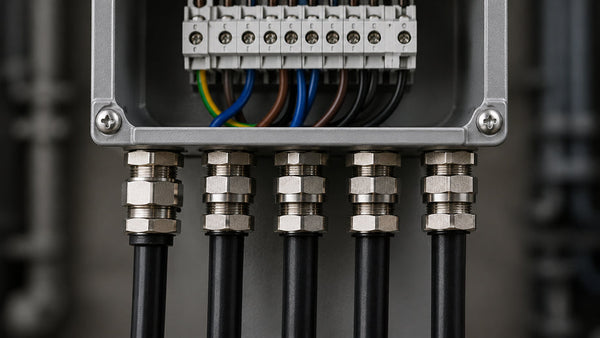
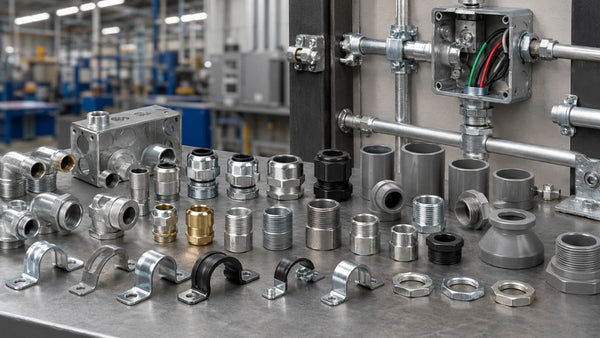
Panel procurement should include the parts needed at each conduit and cable entry. Leaving these details until installation can create avoidable delays, especially when the project requires specific materials or environmental protection.
Conduit hubs and connectors
Specify the raceway type, trade size, thread, enclosure entry, and required environmental rating. A connector for one wiring method is not automatically suitable for another.
For example, Eaton offers Myers hubs for terminating rigid conduit and IMC through enclosure walls, with ratings and features that vary by product. Review the exact part’s documentation rather than extending one model’s approval to an entire product family. See Eaton’s Myers hub specifications.
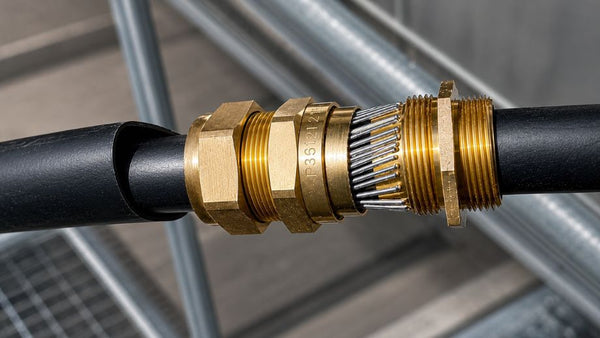
Cable glands and cord grips
Record the cable type and outside diameter along with the entry thread. A gland with the correct thread can still have the wrong cable gripping range.
Industrial Fittings Now’s cable glands and cord grips collection includes products with different entry sizes and cable ranges. Check both measurements before choosing a part.
Liquidtight fittings and classified locations
Where the design calls for a liquidtight wiring method, specify compatible conduit and connectors for the installation. Browse liquidtight fittings using the approved bill of materials.
For hazardous locations, include the location classification and the required product markings in the request. “Weatherproof,” “liquidtight,” and “explosionproof” are not interchangeable specifications. The complete installation, including entries and any required sealing arrangement, must suit the classified location.
Frequently asked questions about electrical panels
Is a main lug panel the same as a subpanel
The terms overlap but describe different attributes. Main lug identifies the incoming connection arrangement. Subpanel identifies a downstream distribution role. A subpanel can have a main breaker.
Does adding a subpanel increase available power
No. A subpanel provides another distribution point. Available capacity still depends on the service, feeder, protective devices, and calculated loads.
Can any breaker with the same amp rating be used
No. The breaker must be identified for use with the specific equipment. Amperage and physical fit do not establish compatibility. Check the panel labeling and applicable manufacturer documentation.
Is a junction box an electrical panel
A junction box typically encloses connections or splices. A distribution panel incorporates equipment for distributing and protecting circuits. An empty enclosure or junction box does not become a panelboard simply because it is large enough to hold components.
What information should be included in a parts quote
Send the manufacturer and complete part number, required quantity, equipment identification, electrical ratings, entry sizes, and any enclosure or hazardous-location requirements. Include the cable outside diameter when requesting glands or cord grips. Clear label photos and the approved bill of materials can help resolve ambiguous descriptions.
Find electrical fittings for your panel project
Industrial Fittings Now carries industrial electrical fittings and related products from brands including Appleton, Crouse-Hinds, Thomas & Betts, and Killark. Use our catalog to research components for your specified installation, or send your parts list for a quote.
Request a quote, call 713-574-6342, or email Sales@industrialfittingsnow.com with your part numbers, quantities, and project requirements.